Why Southwest Connecticut Schools Are Banning Smartphones
Around the region, school districts, including Norwalk, Fairfield, and Westport, are moving to restrict students' access to smartphones in schools.

For years teachers, advocates, and experts have been sounding the alarm that students’ mental health is declining, their attention spans are decreasing, and their social skills are diminishing.
While the COVID-19 pandemic amplified and accelerated these trends, many of them were in play before 2020. That’s led many to believe there’s a simple answer to these complicated issues: It’s the phones.
Jonathan Haidt, a social psychologist at New York University’s Stern School of Business, has been one of the leading experts on this issue. He authored the book The Anxious Generation, which explores the “collapse of youth mental health” and lays out a plan for a healthier, freer childhood.
“As the teen-mental-health crisis rolls on and rates of depression, anxiety, and self-harm continue to rise, we are not helpless,” Haidt wrote in an article for The Atlantic titled “Get Phones Out of Schools Now.” “Parents, teachers, and school administrators can take meaningful action too, right now.”
Haidt’s work has sparked a movement across the country—and southwest Connecticut—to ban phones in schools.
Just since school started this year, Westport Schools banned cell phones at the high school, Norwalk expanded its ban of phones, particularly at the high school level, and Fairfield adopted phone-free regulations in October.
“The recommendations are grounded in research, practice, and the experiences of our staff and students and the evidence is clear: smartphones and wearable technology during the day diminish focus, undermine mental health, erode peer interaction, and place an undue burden on the faculty members for enforcement,” Westport Superintendent Thomas Scarice told the Board of Education in October.
“Schools that have embraced phone-free environments report stronger academic outcomes, healthier student relationships, and a culture more aligned with the core mission of our schools,” he added.
That mission has been backed up by responses from stakeholders across the region in surveys. Majorities of respondents—teachers, parents, staff, and students—have said they favored limiting or banning access to smartphones during the school day.
For example, Ralph Valenzisi, Norwalk’s assistant superintendent for digital learning and innovation, said through a district-wide survey they received a “number of comments that talked about mental health and constant connectivity and a need to disconnect during the day,” which helped pave the way for the increased restrictions.
That doesn’t mean everyone supports them, as some students and parents have pushed back through petitions like one in Fairfield that’s collected 1,300+ signatures.
Let’s explore why experts say this is the right move and what it looks like in practice across the region.
Experts: Smartphones Impact Mental Health, Attention Spans
Haidt’s research has highlighted the links between excessive phone use—particularly heavy social media use—and declining mental health for students.
“Evidence of an international epidemic of mental illness, which started around 2012, has continued to accumulate. So, too, has evidence that it was caused in part by social media and the sudden move to smartphones in the early 2010s,” Haidt wrote in an article for The Atlantic “Many parents now see the addiction and distraction these devices cause in their children; most of us have heard harrowing stories of self-harming behavior and suicide attempts among our friends’ children.”
And he’s not the only one.
In 2023, the United States Surgeon General issued an “Advisory on Social Media and Youth Mental Health,” which stated that “social media presents a meaningful risk of harm to youth,” as “children and adolescents who spend more than three hours a day on social media face double the risk of mental health problems including experiencing symptoms of depression and anxiety.
In addition to the challenges caused by heavy social media, our devices are also causing attention spans to shrink, according to research from Gloria Mark, Ph.D., professor of informatics at the University of California, Irvine.
Mark said on Speaking of Psychology that young children are particularly susceptible to distractions.
“When they're distracted, it takes them longer to get back and focus again on that thing that they were distracted from,” she said. “So I worry that when young children are spending so much time on the screen, it acculturates them to think that this is normal behavior to be on a screen.”
In particular, Mark noted that children’s brains are not fully developed, such as the parts that manage self-control, and they’re easily distracted by screens.
“I find it problematic that we're putting children into a digital world before some very critical mental functions are fully developed,” she said. “I don't think kids are really ready for that.”
That’s why Haidt’s work has included some solutions, including “Four Norms” that “roll back the phone-based childhood: no smartphones before high school, no social media before 16, phone-free schools from bell-to-bell, and more independence, free play, and responsibility for students.
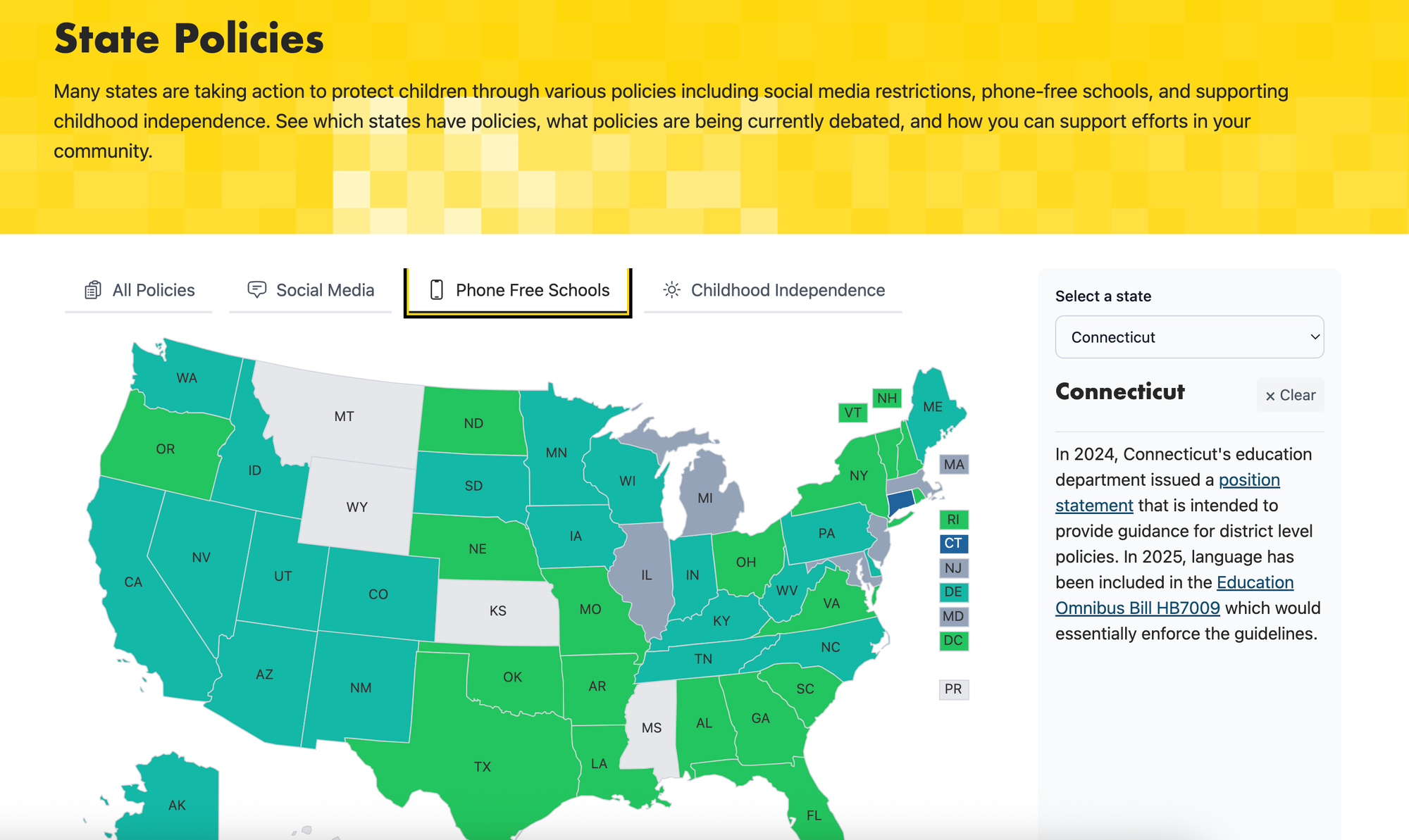
What Is Connecticut Doing About Cell Phones in Schools?
Given the concerns about cell phone use, the state House of Representatives passed legislation that required “local and regional boards of education to adopt a policy each school year…limiting smart device use in the schools they oversee.”
Governor Ned Lamont put out a statement praising the effort, stating that “young people learn best when they are actively listening to classroom instruction and interacting with their teachers and peers, not swiping, clicking, and scrolling.”
However, the Senate never took up the bill. So far all that’s been done at the state level is guidance from Connecticut State Board of Education. The board put out a position statement in 2024 titled “Personal Technology Use in Connecticut Schools: Impact of Social Media and the Use of Cell Phones of Student Learning and Mental Health.”
In it, the Board recommends that districts develop policies around cell phones that “restrict the use of cell phones during the school day to ensure student engagement in learning, support emotional well-being, and strengthen students’ interpersonal skills, peer interaction, and social communication.”
The position statement recommends that cell phones should be removed from the classrooms in elementary school and middle school, and said that “the policy for high school students … should still be restrictive; however, as appropriate, high school students may be developmentally ready to take more ownership of controlling excessive use and understanding responsibilities regarding technology use.”
But while the position statement makes these recommendations, it ultimately leaves the decisions up to the local districts.
Cell Phone Policies in Southwest Connecticut
That’s why across the region different districts are passing different policies limiting access to phones in schools. Some districts have “bell-to-bell” bans, while others have restrictions on phones in classrooms, but allow students to access them outside of the academic settings.
Here’s a look at what districts are doing:
Bridgeport
The district has a blanket policy that states “cell phones or mobile devices are not permitted during school hours for non-academic purposes,” but doesn’t specifically ban students from having them or from using them during lunch or other free periods.
Stamford
Before the start of the 2024 school year, district officials strengthened their cell phones policies in an effort to “limit student access to mobile phones and other devices during the school day,”
At the elementary school and middle school level, the use of “cell phones and other electronic devices is prohibited unless directed by the principal.” If students bring the devices to school, they must be silenced and stored in their backpack for the entire day.
At the high school level, students are required to “silence and store their cell phones and other electronic devices during instructional time.” The district added “over-the-door storage pockets” to classrooms where students can place their phones during classes. The district does allow students to use phones “during lunch, transitions between classes, and other times students are not receiving instruction.”
Norwalk
Officials are updating their regulations to institute a “bell-to-bell” ban for K-12. Previously, the district did not allow access to cell phones at all for K-8, but had some limited exceptions for K-12.
Ralph Valenzisi, assistant superintendent for digital learning and innovation, said the district surveyed parents, teachers, and students and from the 1,700+ responses they received, almost all wanted more restrictions on phones during the day.
Teachers and parents pushed for phones to be banned at lunch and during passing periods in the high school—which is what the district ultimately decided to do—while students had asked for some leeway with phones during those times.
“From the K-8 standpoints, they really felt strongly that not having the phones during the school day was a good thing—that was very resounding feedback in general,” he told the Board of Education in September. “At the 9-12 level, there was a little bit of a mix: some parents supported limited use, but most wanted the same situation as K-8. They see phones as harming study time and social interaction.”
Fairfield
Fairfield instituted a “bell-to-bell” ban for all grade levels back in October, after previously allowing high school students some access to phones during lunch. Middle school students can keep a phone in their lockers during the school day, while high school students must keep their phones in a “school-issued secured phone pouch from the first bell of the school day until students are dismissed for the day.”
Officials said the reason for the ban was to “foster an optimal learning environment free from digital distractions and to promote direct interpersonal interactions among students.”
“We recognize that cell phones are a part of modern life, but their use in school must not disrupt the learning process or compromise the school environment,” a statement from the district reads.
Students, however, have raised some objections, including through a 1,300+ signature petition. The petition said that keeping phones in schools “promotes safety, enhances learning, and prepares [students] for the digital world. In emergencies, phones enable immediate contact with family and emergency services, providing reassurance and quick assistance. Academically, phones offer instant access to educational resources, aiding research and collaborative projects.”
Greenwich
In August 2024, the district updated its cell phone policies, implementing a “no cell, bell-to-bell for K-8,” where phones should either not be brought to school or kept in backpacks and lockers for the entirety of the day. At the high school level, the policy states that “phones should be away all day.”
Greenwich officials said the reasons for these differences are because high school students are “preparing for university and work life. The district believes that self-regulation is an important skill to learn.”
In addition, the district said that it understood that “GHS students are very busy and activities after school often mean students are on campus or returning from activities after dark. Having a personal cell phone may be seen by parents/guardians as a safety mechanism for their child.”
Officials said they heard the concerns of parents “about the effects of early and excessive cellphone and social media usage.”
“We are keenly aware of how device usage is impacting the mental health of young people, and we aim to be responsible, supportive, and responsive in all aspects of digital use,” the district said in a statement.
Darien
Ahead of the 2025-2026 school year, Darien enhanced its cell phone regulations, banning the use of cell phones from grades preschool through 11th grade. For students in ninth through 11th grade, “cell phones must be stored in assigned sealable pouches and kept in student backpacks throughout the school day.”
At the elementary and middle school level, the use of phones is prohibited and if students are sent to school with phones they must remain powered off and stored away.
For seniors in high school, the district policy allows them to “have the privilege of accessing their phones in the Senior Cafe area during non-lunch blocks,” and they “are not required to use the pouch system.”
Westport
Earlier this month, Westport moved to a “smartphone-free environment” requiring students to keep their phones off their person and in their lockers. Previously, the ban only applied at the K-8 schools, but was expanded to include Staples High School on November 5.
“In June 2024 I recommended in writing to the board to restrict access to smartphones and wearable devices during the school day across all grade levels,” Superintendent Thomas Scarice told the Board of Education at its October meeting. “Since then, the phone free initiative has been very successful at the K-8 level.”
Scarice said that the district decided to move to a phone-free environment because “of the addictive nature of the devices and the burden on faculty to be the enforcers in the classroom and because we have a really good opportunity here to increase engagement, positive human interactions, and positive interpersonal connections.”
Cell phones must be kept in students’ lockers at all times, and the district built in five extra minutes at the end of the day to make sure students have time to retrieve them.
How Can I Get Involved?
Almost all of the districts that have recently updated their policies have cited working groups/collaborative efforts with parents and community members. Explore your district’s website to find out more about how to get involved there.
In addition, across southwest Connecticut, there are local organizations and parent groups working to help support less screen time for students as they are developing.
For example, there are at least four chapters of “Ok to Delay” groups in our region including in Greenwich, Darien, Westport, and Norwalk.
“Ok to Delay” is a grassroots group of parents that aim to protect middle school students and keep them “free from the pressure of early smartphones and social media.”