What’s in Westport’s Proposed 2026-2027 Budget?
Westport is proposing a $266.1 million budget for the 2026-2027 fiscal year.
Between the town and the school district, Westport is proposing a $266.1 million budget, a 5.2% increase from the previous year.
As a part of First Selectman Kevin Christie’s first budget, he proposed a $89.5 million budget for the town operations, up 1.96% from the previous year. With separate budgets for the Health District, Library, Earthplace, and Transit District factored in, the overall town side of the budget accounted for $97.2 million, a $1.9 million increase over last year.
“Municipal budgets are often described as just numbers on a page but they really reflect the community’s priorities and community’s values,” Christie told the Board of Finance in March. “In Westport, Westporters expect a town that runs well, is fiscally responsible, and capable of delivering high quality services while planning responsibility for the future.”
On the school side of the budget, the Board of Education recommended a $157.9 million budget, just under a 5% increase from last year.
“How we spend money is what we value, Westport values education,” Board Chair Lee Goldstein told the Board of Finance. “Our schools are remarkable and that’s what this is about.”
Superintendent Thomas Scarice told the board that the “funding for our schools has been incredible in my six years here.”
However, he noted that most of the budget increase was due to rising healthcare costs, so if the budget was reduced “we’re going to need to adjust our expectations for Westport Public Schools.” Scarice gave the example that about 98% of Westport high schoolers could get the classes they want right now—”Kids just don’t get their courses in every high school, here they do.” If the budget was cut, that might have to change due to staffing adjustments, he said.
What’s in the proposed budget?
On the town side, Christie noted that the budget aims to maintain the current quality of service the town offers and address infrastructure needs—both physical ones and also technological upgrades. He highlighted that the community receives a large “scale of services [that] this incredible team provides.”
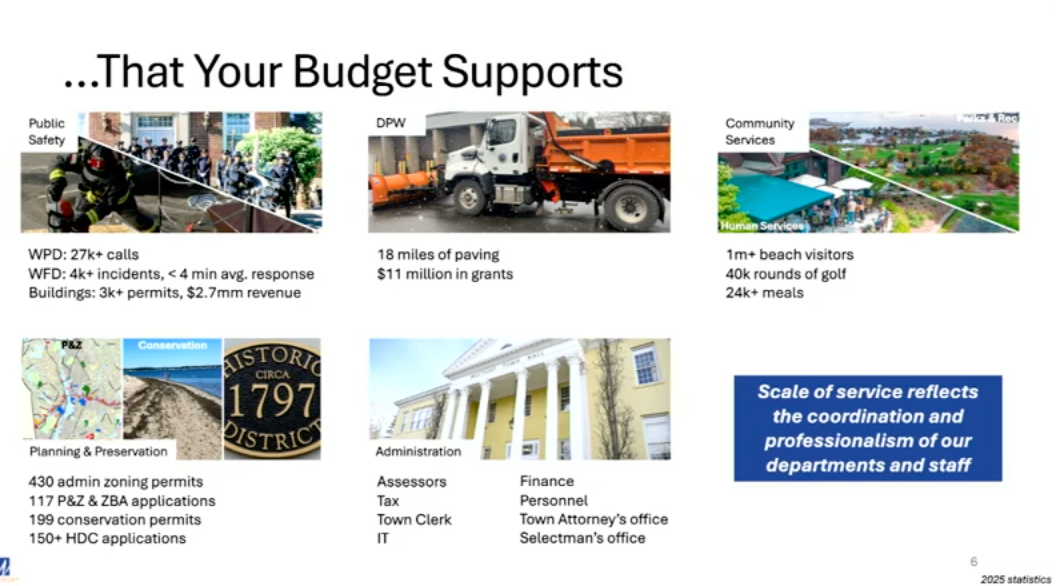
Some of the enhancements included in the budget are an increased focus on funding for sidewalk and snow removal services as well as enhancing the IT department’s capabilities, particularly to support better technology for government meetings.
On the Board of Education side, healthcare costs saw a 15% increase. Goldstein noted that the board voted to use $750,000 from its healthcare reserve account to “shoulder some of the burden of this increase and bring it back down a little bit.”
However, some Board of Finance members said that the move looked like an optical play to make the increase look less than it truly is.
Goldstein pushed back stating that the board was “not trying to change the optics. The increase is 5.5%, 3% excluding healthcare.” She noted that the “healthcare reserve is at the top” of what is required, so the Board of Education felt it was ok to use some of it to offset the increases.
In addition, the budget includes funding for bringing board certified behavior analysts (BCBAs) in house, instead of using a consultant model. Goldstein said this move would double the amount of time these specialists could use to support students for roughly the same cost. The consultant contract of $417,649 provided about 1.5 BCBAs, while the board estimates that 3 full-time BCBAs would cost $464,000.
The budget also includes adding an assistant director of facilities and security to help manage all of the capital projects going on in the district. The additional cost would be about $87,000 thanks to some restructuring, according to Scarice. The district’s health services supervisor is retiring so the plan is to maintain that position, but at a lower salary and cost, and use some of that savings to pay for the new assistant director.
Scarice reiterated that if there are reductions they would be “going into our current programs.”
What are the next steps?
Members of the public are invited to attend two Board of Finance Public Hearings—one on Monday, March 9 on the Board of Education budget and one on Tuesday, March 10 on the town budget, both starting at 7:30 p.m. This is a chance for residents to weigh in on the budgets before the Board of Finance votes on them.
Once the budgets are approved by the Board of Finance, they go onto the Representative Town Meeting for final adoption. The RTM cannot add money to the budgets, but they can reduce them. After the budgets are finalized, the Board of Finance will set the mill—or tax—rate for the town.
You can read the full town budget or see the school district’s budget online.