What’s in Norwalk’s 2026-27 Budget?
Norwalk's new mayor Barbara Smyth is proposing a $483.9 million budget for 2026-27.
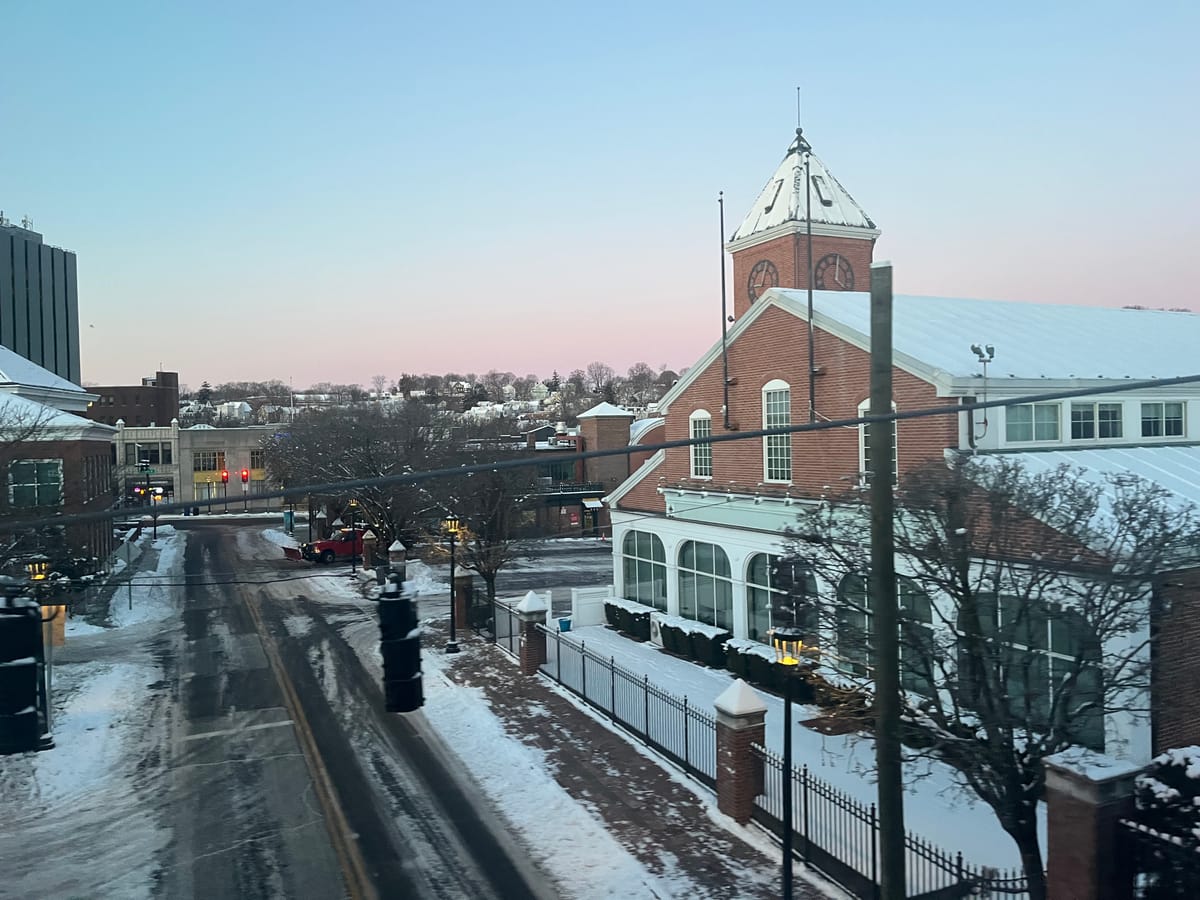
“This is a challenging budget year for Norwalk,” Mayor Barbara Smyth told the Board of Estimate and Taxation on February 9.
For residents of Norwalk, that’s a phrase they’ve heard for years, even though this was Smyth’s first budget as mayor—although she had been part of many as a City Council member.
Her proposed $483.9 million budget would be an overall 7% increase from last year’s approved budget. It includes a 10% increase for the city’s side of the budget, going from $204.9 to $226.9 million and a 4% increase on the Board of Education’s side, going from $247.2 million to $257.1 million.
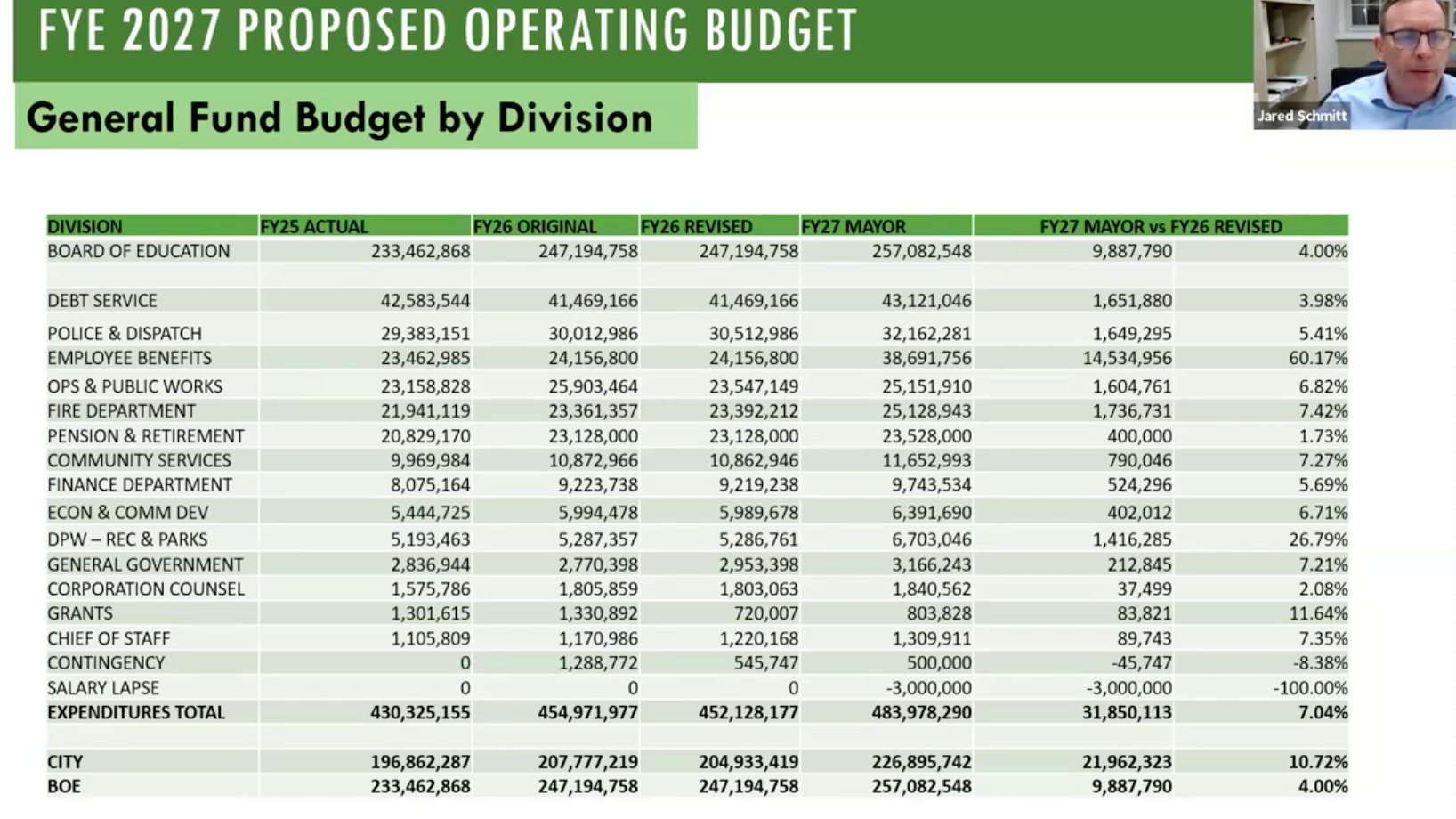
Those increases alarmed members of the Board of Estimate and Taxation (BET)—the city’s financial body—and members of the City Council.
“I’ve been on this board for a number of year—the city side has always been the cost of inflation or lower. It is alarming to me seeing this for the first time,” said Troy Jellerette, a member of the BET. “I thought we were going to have a ‘glide’ year. I just think that number is very high.”
“I don’t think I’ve ever seen it like this before,” City Council member Jim Frayer, who chairs the Finance and Claims Committee of the council, said at the committee’s public hearing on February 12.
What’s driving the increases?
City officials said that there are three main areas that are driving this increase. The first is that it settled six union contracts this past year, driving salaries and benefits higher. Smyth said that moving forward they’ve “spread out the negotiations so they won’t hit us all in the future,” at the same time.
The second is “skyrocketing health care costs” and a need to replenish the internal service fund. Norwalk’s Chief Financial Officer Jared Schmitt, who started in 2024, said in previous years the city had used the balance of that fund, which includes healthcare, liability insurance, and workers compensation to "subsidize our appropriations over the past few years.”
“We’re not in a place where we can do that anymore,” he said.
And the third is the fact that the city is in the third year of its revaluation phase-in. Every five years, the state requires cities to update their property values through a revaluation process. When the city went through its revaluation process in 2022, it was during a very hot residential market, while the commercial side was struggling coming out of the pandemic. That shifted the tax burden to residents.
As a way to mitigate the higher home prices, the BET voted to phase in the increase over four years. While that move helped homeowners avoid a large jump in their tax bills, it also prevented the city from capturing as much tax revenue as it would have with the higher property values.
Smyth said that the goal of the budget is to “put Norwalk on stronger footing for the future.”
“We want to avoid short-term decisions that create bigger challenges down the road,” she said.
The chart below shows how the proposed budget would impact residents in the six taxing districts across the city.
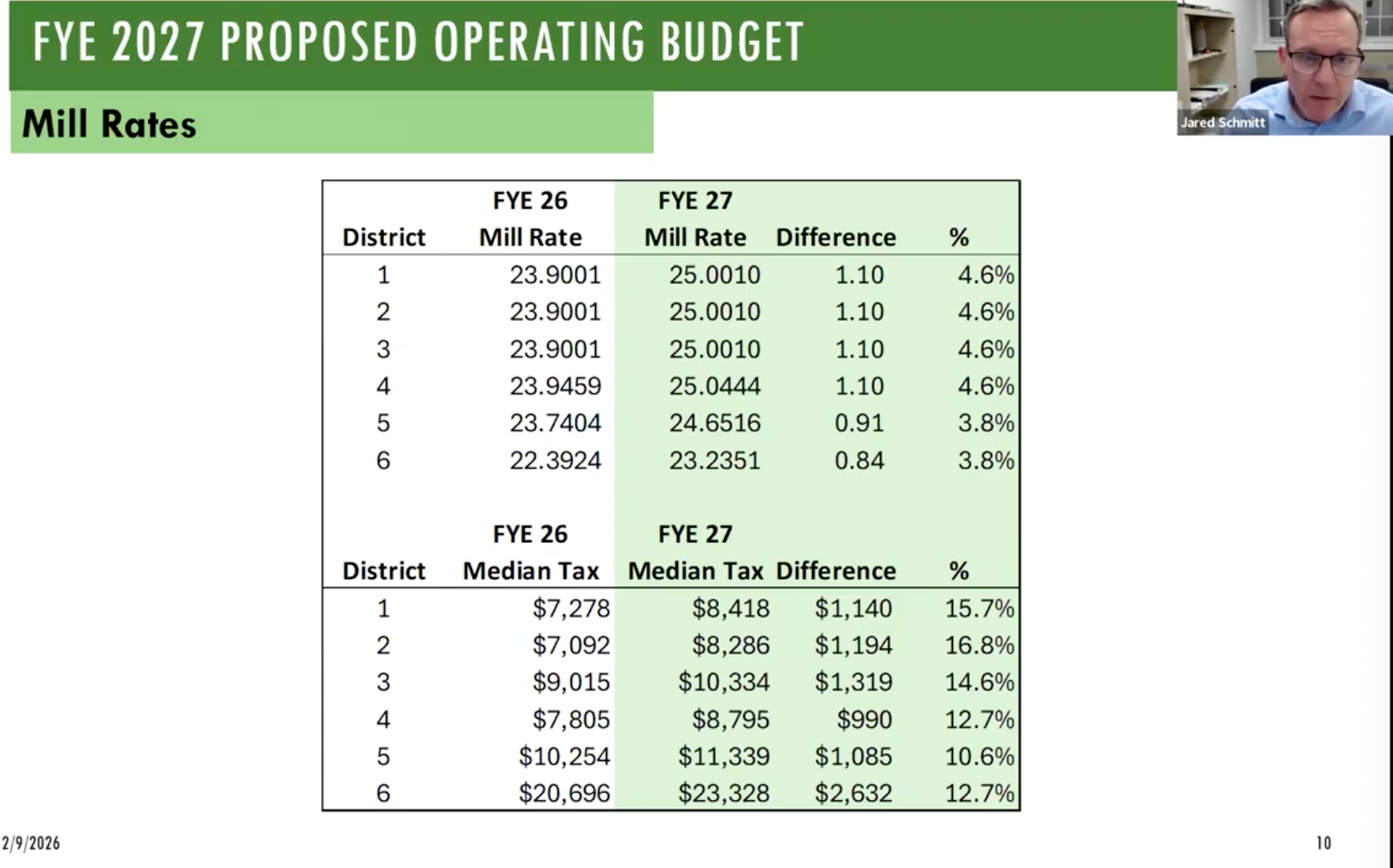
But even with the increases, the budget still doesn’t fully fund the Board of Education’s request. The board approved a budget with a 6.5% increase, while Smyth’s proposal only includes a 4% raise for the schools. Last year, the city and schools faced a prolonged budget fight as deep cuts to programs like music were proposed to close the budget gap. Ultimately, the city allocated additional funding—as did the state—to stave off the most drastic cuts.
What do residents think of the initial proposed budget?
From the residents that spoke at the Finance and Claims Committee’s public hearing, most were concerned with not fully funding the Board of Education.
Mandy Singh, a parent at Cranbury Elementary School, said that parents “urge the committee to fully fund the BOE’s budget that they requested.
“When we find out in may what’s going to be cut you’re going to have a lot of angry parents,” she said. “Parents are out there. We care.”
Sarah Rabito, a parent from the Concord Magnet School, said that the “kind of instability” that the schools faced last year “should not become our norm.”
“The schools must be a top priority and the budget gap needs to be closed,” she said. “Ultimately our students lose. Classroom staffing matters, special education staffing matters.”
But others, like Lisa Brinton, who chairs the Independent Party in Norwalk, emphasized the need for a “thorough revenue” discussion, emphasizing a deeper conversation around the city’s Grand List, which is the value of all taxable property in a community.
“Who on the Finance Committee knows the status of the Top 50 largest commercial properties, their values and tax status in town?” she asked. “After more than a decade of nonstop construction, 19,000 homeowners still pick up the majority tab for a city approaching 100,000 people.”
The concerns about funding the Board of Education resonated with members of the City Council, who pondered whether they could fully fund the schools—either by reducing the city’s budget or fully funding both.
“My constituents are riled up about the BOE—people are more passionate about the schools than other services,” Council member Brian Bailey said.
Bailey asked Schmitt to think about what cutting money from the city-side would look like, namely what programs or staff would be cut.
“Likely there’s going to be pain from the other side of the budget, we should sort of articulate those choices,” he said.
What’s next?
(Updated as of Sunday, March 1)
The City Council unanimously voted to raise the budget cap from what Mayor Barbara Smyth initially set—moving it up to $486.2 million, from the proposed $483.9 million. The goal was to increase the amount of funding the Board of Education would receive.
Now that the cap is set, the budget moves to the Board of Estimate and Taxation.
Members of the BET indicated that they would be looking to find reductions.
“I would instruct every single department head, as we get into our deliberations, that they should be expecting to defend every single line in the budget,” Chair Ed Abrams said. “I will not accept an answer of, ‘We held this flat to last year.’
From there, the BET will be conducting its hearings with staff members from Tuesday, March 3 through Thursday, March 19. There will be a public hearing on Wednesday, March 25 where residents can give their feedback on the proposed budget, before the BET finalizes its budget by April 6.
You can see the full calendar on the city’s website. You can also explore the line-by-line budget breakdown and see the CFO’s presentation deck.