Report: 40% of Lower Fairfield County Residents Struggling to Make Ends Meet
More than 93,000 residents across lower Fairfield County have to "make impossible choices," according to a new United Way report, such as deciding whether to buy food or fill a prescription.
Fairfield County is home to some of the wealthiest areas in the entire United States, and it also has some areas of poverty. In between some of those extremes are families who are ALICE—Asset Limited, Income Constrained, Employed—meaning they live above the federal poverty line, but struggle to make ends meet.
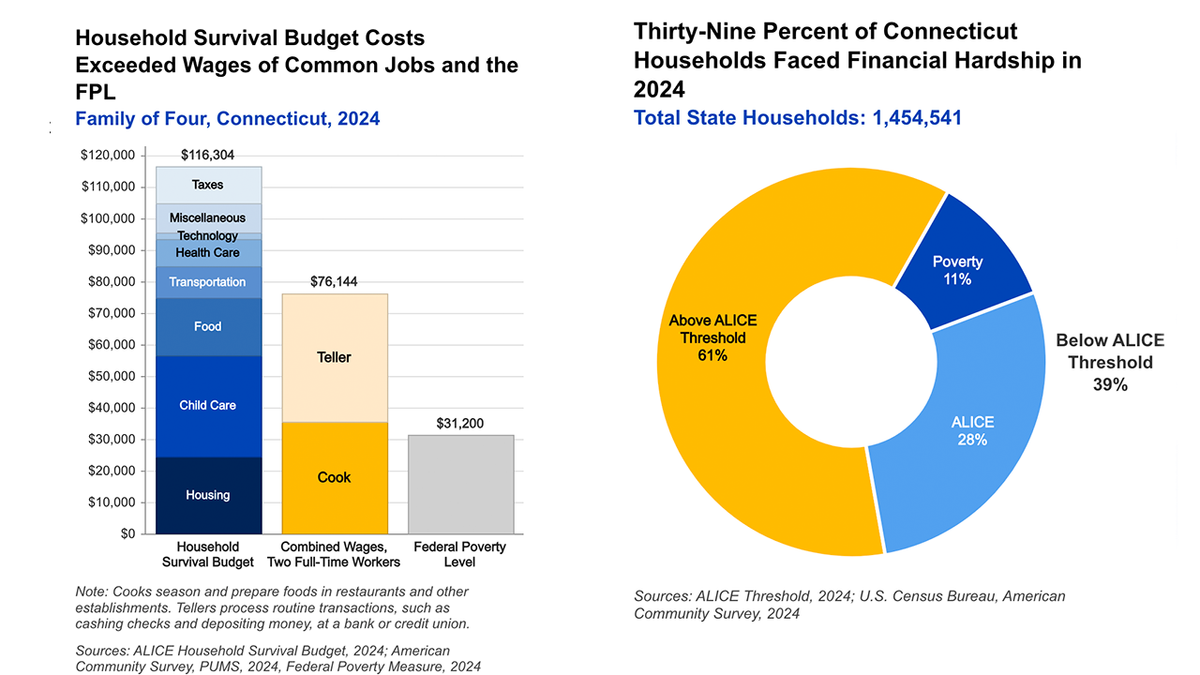
A new report found that nearly 30% of Connecticut residents are ALICE. When those are combined with those at or below the federal poverty line, it shows that nearly 40% of residents face financial hardship. In our region about 40% of residents are considered ALICE, according to the report.
The report from United Way of Connecticut says that a “household survival budget” for a family of four living in Connecticut is $116,304—dramatically higher than the federal poverty level for a family of four, which is $31,200. But looking at average salaries for two full-time employees, in this instance a bank teller and a cook, their combined wages are $76,144, leaving a large gap between what the family needs and what they’re earning.
“Households below the ALICE Threshold don’t have enough income to afford their basic needs,” the report stated.
The report found that people below the threshold are often “forced to make impossible choices,” which can include “deciding whether to pay for utilities or a tank of gas; whether to buy food or fill a prescription; whether to live close to work and pay more for housing or opt for a longer, more costly commute.”
In addition, people at this threshold are “less likely to have the resources to cover unexpected household expenses (like an unforeseen car repair or a costly medical bill), or to recover from crises, both widespread (like a natural disaster or public health emergency) and personal (like the loss of a job or family member),” according to the report.
The report said the federal poverty “is obsolete” as it does not “consider the wide variation in cost of living by location,” and its “methodology has not been updated since it was formulated in the 1960s, despite changing economic conditions.”
“As a result, the official poverty rate sharply underestimates the true extent of financial hardship in the U.S.,” the report stated.
But what does this look like on the ground and what impact does it have on residents? Let’s dive in.
ALICE in Lower Fairfield County
Looking at data, which is from 2024, from 27 zip codes in our region, about 40% of residents or 93,545 are below the ALICE threshold. This includes both families that fall below the federal poverty line and those that are considered ALICE.
But not every zip code faces the same challenges. For example, 06853, which is Rowayton (a small part of Norwalk), and 06878 which is Riverside, a part of Greenwich, have between 15% and 16% of their residents considered ALICE. Meanwhile, three zip codes in Bridgeport including 06608, 06610, and 06604 have more than 70% of their residents considered ALICE.
Who are the residents considered ALICE?
While the report found that there were households below the ALICE threshold for all types of demographic groups, some faced higher levels of financial hardships.
Across the state, the groups with the highest percentage of households considered ALICE included:
- Hispanic households (58%)
- Black households (56%)
- Households headed by people under age 25 (74%)
- Households headed by people age 65 and over (47%)
- Single-parent-headed households (73% single-female-headed, 54% single-male-headed)
Older households, those headed by residents 65+, saw the biggest increase in the total number of households living below the ALICE Threshold.
When looking at industries, workers in “accomodation and food services” were most likely to fall below the ALICE threshold. Looking at occupations, the report found that maids and housekeeping cleaners, as well as janitors and building cleaners were most likely to fall below the threshold.
Residents who are considered ALICE often perform many of the jobs that “keep our economy functioning smoothly,” according to the report, including working as “child care providers, food service workers, cashiers, personal care aides, delivery drivers, and more.” Still, they have to make hard choices, between working and paying for child care, food or transportation.
What can be done to support ALICE residents?
One of the biggest challenges the report outlines is that there’s no easy fix as the “reasons that households face financial hardship are complex and interrelated.”
Some targeted interventions can address some of the challenges, such as working to tackle food insecurity or reducing the housing cost burden. However, the report noted “improving overall financial stability for the long term requires more comprehensive strategies.”
“Coordinated action is needed across multiple levels—including household supports, community infrastructure, employer practices, and public policy—to address the upstream conditions that contribute to persistent hardship for ALICE households in the state and across the nation,” the report found.