Norwalk, Fairfield Respond to September’s “Brutal Storm”
The September 13 storm flooded roads, damaged homes, and caused major challenges for cities across Lower Fairfield County.
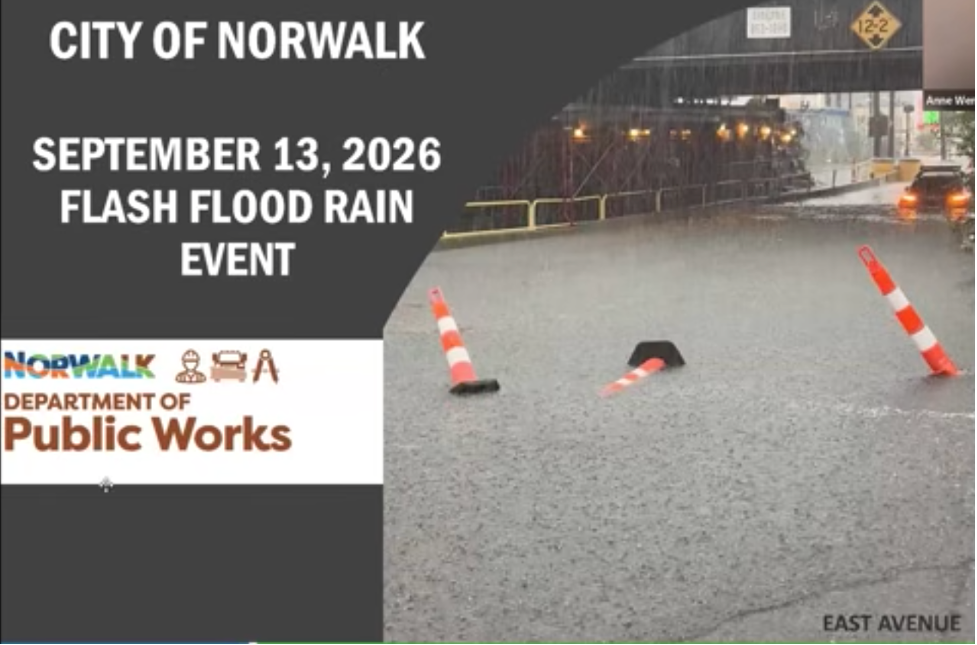
On September 13, at least 5.5 inches of rain fell across lower Fairfield County in a three-hour period, with many areas even harder hit. The county, along with New Haven and Litchfield counties, received a disaster declaration from the federal government.
“It was a brutal storm,” Norwalk’s Chief of Operations and Public Works Vanessa Valadares said.
Valadares gave the Public Works Committee of the City Council a look into the storm event, which flooded city roads, businesses, homes, and more.
“This storm was as big as [the 2021 Tropical Storm] Ida—the only good thing about this storm is that we didn't have any wind. The flooding, the amount of rain that we got was really unbelievable,” she said.
The city received more than 110 service requests that day as many residents who hadn’t experienced flooding in their areas before were affected.
But Norwalk wasn’t alone.
In Fairfield, many parts of the town were underwater, particularly areas near the Rooster River.
“After the September 13 flash flood, all areas of town were flooding, and properties that never flooded before saw water,” Fairfield First Selectperson Christine Vitale said at an October 1 Board of Selectmen meeting.
Bill Hurley, Fairfield’s engineering manager, told the board that between two storms in the late summer, including the September 13 one, the Rooster River went up eight feet in one hour.
Let’s explore what happened that day and what these communities have been doing to respond.
A Look into September 13
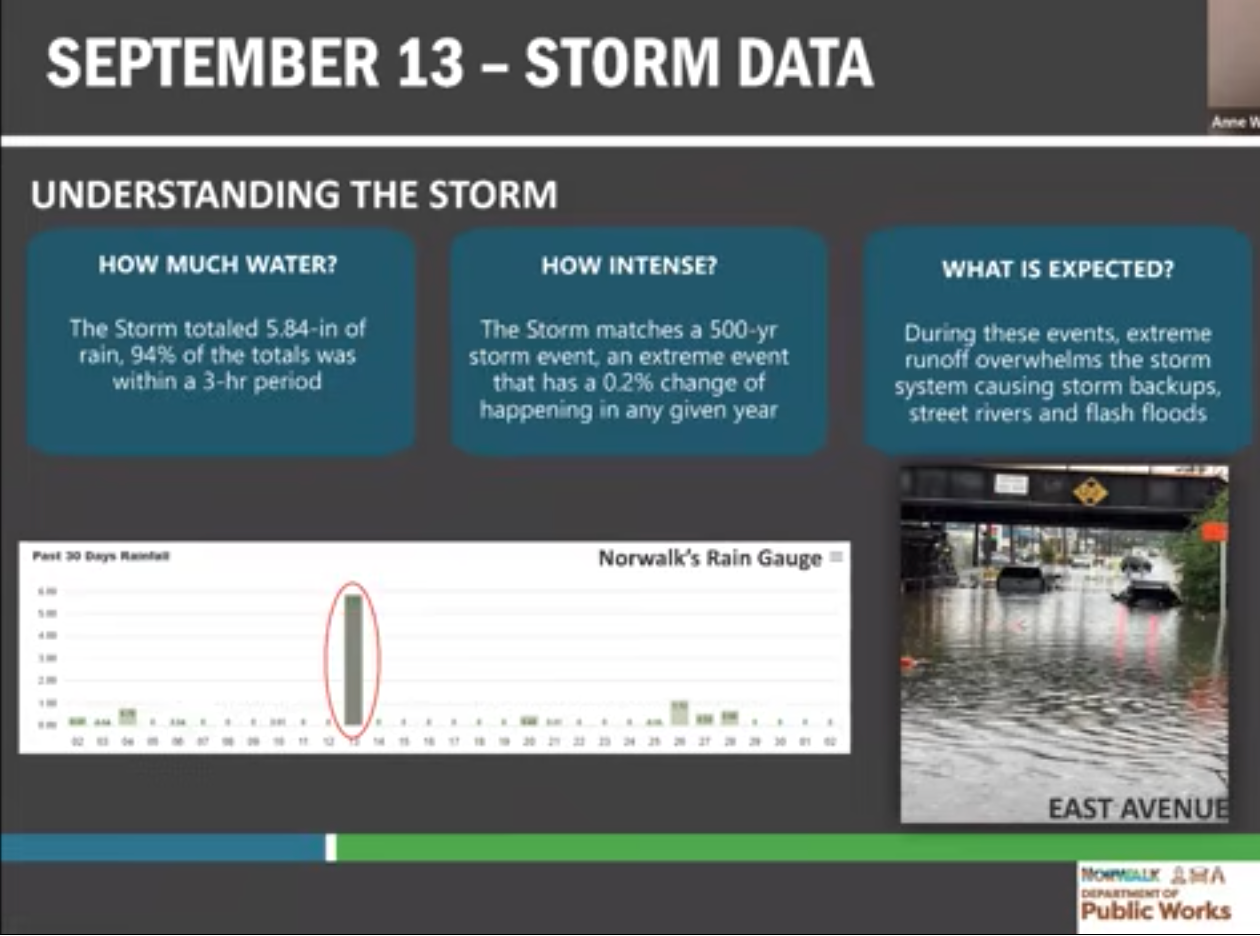
Valadares said that the vast majority of the nearly 6 inches of rain the city received fell in just a three-hour period. It was that amount in such a short period of time that caused issues, she said. Valadares described it as a 500-year storm meaning that there’s a 0.2 percent chance of that kind of storm happening in a given year.
The city designs its infrastructure to withstand usually 25-year storms, meaning storms that have a 4% chance of happening each year.
“If it rains 6.49 inches of rain in 24 hours, our pipes will handle it—that is a 25-year-storm for a pipe,” Valadares told the committee. “We got just less than six inches on this storm, but the issue was that we got it in three hours. If we got the same amount of rain within 24 hours, it would have been a 25-year-storm, so the flood impact would have been much less.”
Still, while this type of storm can be rare, officials noted they are happening more frequently.
Fairfield Selectperson Brenda Kupchick asked if the town was going to be adding to its efforts to do things before a storm hits “based on what’s happening with the climate.”
“I think we're in a new world, and we're going to be getting this stuff—I don't think we're ever going back to where we used to be,” she said. “This is our new norm. We're getting flooded. And what I'm asking is the town going to go around not just because we know a storm's coming, but are we going now around to look at all of these places to see what's going on there? Is there something we can mitigate this debris going in and clogging it, or can we fix something here that might help it? Are we doing that kind of analysis?”
Both communities said they try to do preventative maintenance, like cleaning storm drains in problem areas ahead of storms like these, but when a storm is this large, sometimes that’s not enough.
Investing in Infrastructure
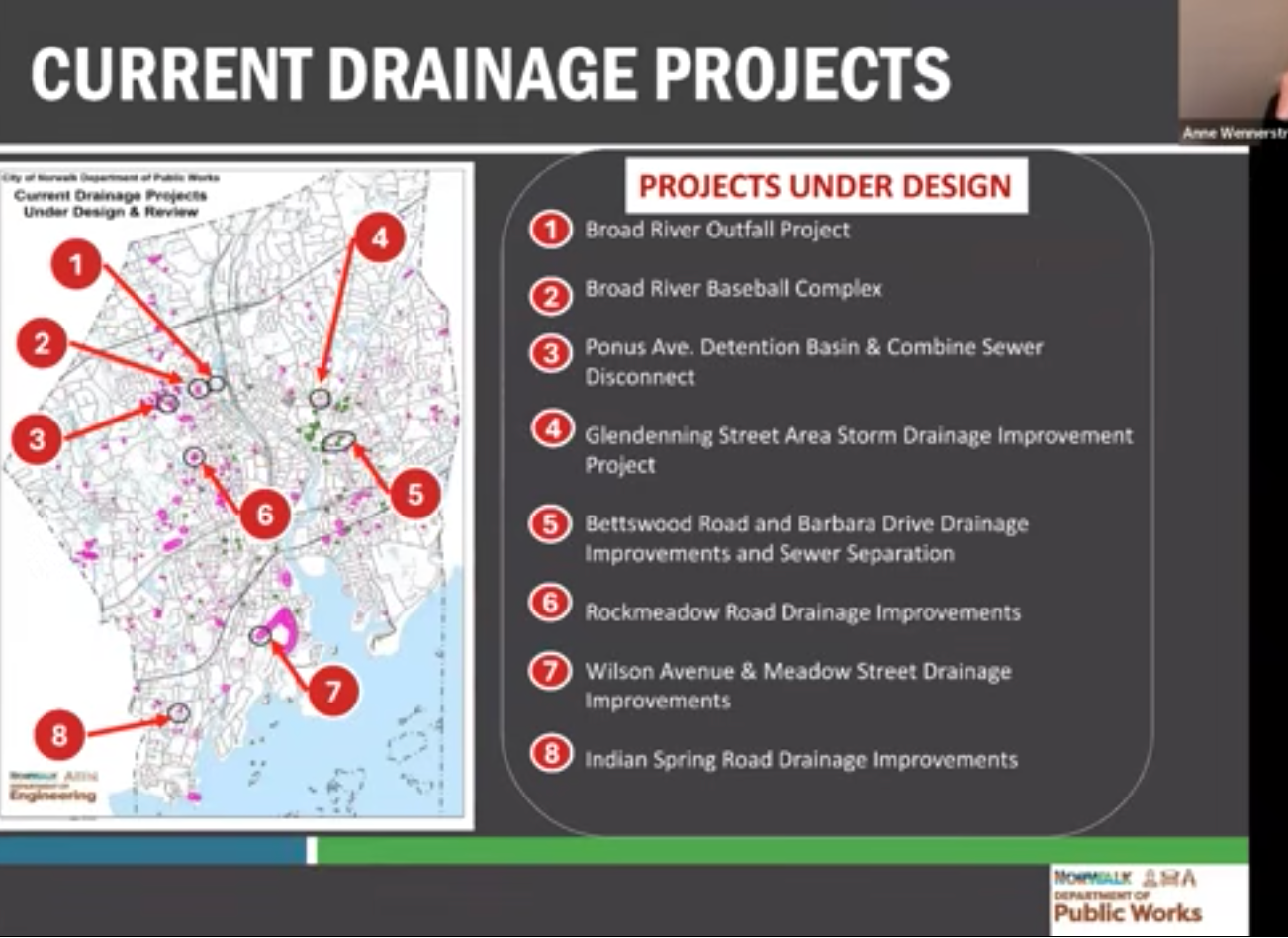
In both Norwalk and Fairfield, officials said that they have been working to invest in their stormwater infrastructure. Norwalk has invested about $17.5 million in drainage in the last four years, and Valadares said that the storm could have been even more for people if some of the projects had not been completed. In addition, there are at least eight other major projects in design work to try and combat some of the flooded spots.
“We know where the critical areas are, and we try to really spread the drainage improvements throughout the city,” she said. “So we try to tackle all the areas throughout the city that have a lot of flooding issues. So Ponus, that is our next major area. This area really has been suffering a lot. It is very hard to do all the projects that they need.”
But she noted that it’s not as simple as deciding to just tackle a problem as funding, engineering, and permitting can take months. Valadares said that the quickest turnaround they’ve seen for projects is two years.
In Fairfield, that’s something the residents know all too well as the Rooster River mitigation project has been in the works for years.
The plan was to work on the $8.2 million project in phases. Officials initially awarded contracts in August for the work on the detention basins at the Fairfield Wheeler Golf Course and Tunxis Hill Park to Grasso Construction, according to Adam Tulin, the town’s director of purchasing. But as conversations progressed, the company asked to have its bid withdrawn for the Tunxis Hill portion to “allow them to focus on the Fairchild Wheeler project.”
That prompted the town to decide to go with the second lowest bidder for the Tunxis Hill piece, Priority Landscaping LLC, but it needed to be reauthorized by the boards. The Board of Selectmen unanimously approved it.
“It's my understanding they're prepared to start work as early as next week, and we wanted to get this done as soon as possible because every day counts right now for this project,” Tulin told the Board of Selectmen at the special meeting on Oct. 1.
Work began on the Fairchild Wheeler piece in late September, and the town is also working on a flooding master plan to try and address some of these challenges.
“Mitigating flooding along the Rooster River has been a priority for Fairfield. After years of planning and permitting, it is exciting to see that construction crews are in place and the work is beginning,” Vitale said in a statement. “As we continue to see more unpredictable weather and intense rain events we need to be proactive in planning for the future. I spent a lot of time in those neighborhoods that were most severely impacted by the September 13 storm. I understand the frustration and anxiety of our residents and hope that seeing that work is beginning will provide some comfort that plans are now being put into action.”